
Bringing My Experience to the Colorado House
Whether it was fixing innefficient systems, elevating student voices, or standing with educators, my work on the DPS Board and in the Democratic Party of Denver was guided by the same principles I’ll bring to the State Legislature.
I’m running for House District 2 to keep delivering results for our community.
Select + for details
-
The challenge:
Teachers in Denver Public Schools — particularly at innovation schools — had seen critical job protections and workplace rights waived under previous policies. This created instability in classrooms and weakened educators’ ability to advocate for fair working conditions.
What I did:
I co-wrote and introduced a policy with Board President Xóchitl Gaytán to strengthen teacher protections by ensuring that all schools — including innovation schools — follow the Denver Classroom Teachers Association contract and Colorado’s statutory non-probationary status protections. This work helped restore collective bargaining rights and statutory job protections that had been reduced under earlier governance models.
The result:
In March 2022, following extensive public testimony and debate, a majority of the Denver Board of Education voted to approve the policy — a step that restored collective bargaining and statutory protections for teachers across the district.
Why it matters:
Teachers deserve stable working conditions, a real voice in their workplaces, and clear job protections that allow them to focus on their work without fear of arbitrary dismissal or inconsistent employment terms. Protecting collective bargaining and statutory rights strengthens fairness in public institutions.
-
The challenge:
For many years, Denver Public Schools relied on purchasing paper RTD tickets and distributing them to students who could not afford them — a system that was inefficient, administratively burdensome, and prone to errors. Too often, students still faced barriers getting to school, work, or after-school programs.
What I did:
Beginning in 2020, I spent three years advocating with both RTD and DPS leadership to move away from the flawed ticket-distribution model and toward a simpler, more equitable way for students to access public transit. I partnered with RTD Director Kate Williams and we consistently advocated for students to get on the bus for free by simply showing their school ID.
The result:
That sustained advocacy helped elevate the need for systemic change and contributed to the broader momentum that led to RTD’s Zero Fare for Youth program, which now allows young people to ride RTD buses and trains for free. I was an early and persistent voice for universal student access to transit.
Source: RTD and local leaders announce launch of Zero Fare for Youth (August 2023)
Why it matters:
Students shouldn’t miss school over a bus ticket that didn’t show up. Removing transportation barriers improves attendance, expands opportunity, and supports a more climate-friendly city.
-
The challenge:
Denver Public Schools did not have a formal climate policy to guide sustainability and environmental responsibility, even as students across the district were calling for meaningful action on climate change.
What I did:
I partnered with DPS Director Carrie Olson and spent months meeting directly with DPS student climate groups to draft a student-initiated climate action policy. We worked collaboratively to turn student advocacy into clear, actionable policy language that could be implemented by the district and supported by the School Board.
The result:
In April 2022, the Denver Board of Education unanimously passed DPS’s first-ever climate action policy, marking a shift in how the district approaches sustainability and long-term planning.
What changed because of it:
This policy has influenced more climate-conscious decision-making across the district, particularly when upgrading and building school facilities. One tangible outcome is the Responsive Arts & STEAM Academy, which became DPS’s first all-electric school building, using electric heating and systems instead of fossil fuels — a clear example of how climate policy translated into real-world action.
Source: DPS Building All-Electric School — Denver Public Schools Sustainability (Feb. 14, 2024)
Impact and recognition:
This student-led, Board-supported work also gained national attention. In June 2023, Vice President Kamala Harris visited Denver to recognize DPS students for their climate leadership and the district’s progress on sustainability.
-
The challenge:
Many of Denver’s most consequential local elections are nonpartisan. At the same time, these elections have increasingly attracted outside spending from corporate special-interest money, while voters often lack clear, accessible information about the candidates.
In recent cycles, the Denver Republican Party has endorsed candidates in local nonpartisan races, while Democrats had no formal endorsement process — leaving voters without a clear Democratic Party perspective in those elections.
What I did:
While serving as the House District 2A Captain and a member of the County Rules Committee for the Democratic Party of Denver, I drafted and introduced a resolution in early 2025 calling for Democratic endorsements in local nonpartisan races.
The result:
The resolution passed, leading to further changes in county and state party rules. As a result, beginning in November 2026, the Democratic Party of Denver will formally endorse candidates in local nonpartisan elections.
Source: Democratic Party of Denver Endorsement Resolution
Why it matters:
This change provides voters with clearer information and ensures voters hear from more than just the Denver Republican Party in local elections. It also helps counter the influence of deep-pocketed corporate special interests by elevating candidates who are accountable to the values of the Denver Democratic Platform. I believe these endorsements will also help increase voter participation in local elections — where turnout has often been below 40% — by giving voters trusted information they can use to make informed choices.
-
The challenge:
Research shows that early school start times can contribute to chronic sleep deprivation among adolescents — affecting attendance, academic focus, increased car accidents, and overall well-being. For years, Denver Public Schools relied on unhealthy schedules that started middle and high school too early for students’ natural sleep rhythms.
What I did:
As a member of the Denver Public Schools Board of Education, I drafted and championed the Healthy Start Times policy, working with families, educators, and operational staff to develop and pass a plan that shifted middle and high school start times later in the morning. This involved navigating the logistical complexities of transportation, scheduling, and community feedback to ensure the change could be implemented smoothly and sustainably.
The result:
In May 2021, the Denver Public Schools Board voted to adopt later start times for middle and high schools — aligning them with adolescent sleep research from the American Academy of Pediatrics.
Why it matters:
Healthy start times reflect a commitment to putting students’ well-being at the center of policy. Getting this right required listening to experts, coordinating with district leadership, and making thoughtful decisions that balanced operational realities with what science says benefits students. It’s the kind of evidence-based leadership I bring to every issue — from education to health and beyond.
-
The challenge:
When I joined the Denver Public Schools Board of Education in 2019, the district lacked a clear governance structure. The roles of the Board and the Superintendent were blurred, operational decisions were often mixed with governance responsibilities, and accountability was unclear. This confusion made it harder for the district to function effectively — and ultimately wasn’t good for students or workers.
What I did:
In 2021, I worked closely with DPS Board President Carrie Olson to implement a policy governance structure for Denver Public Schools. This shift clarified how the district operates by:
setting clear goals and expectations for the Superintendent
defining distinct roles and responsibilities for Board members
and establishing operational guardrails so day-to-day decisions could be made effectively and transparently
As part of making this governance model official, the Board implemented over 30 policies in a single vote to align the school district with the new structure.
The result:
This governance structure brought clarity, stability, and accountability to Colorado’s largest school district. It remains in place today, providing a durable framework that improves decision-making and supports both workers and students.
Why it matters:
Good governance isn’t abstract — it determines whether large institutions work for the people they serve. By clearly separating governance from operations and aligning policies behind shared goals, this structure improved how DPS functions day to day. It’s the same approach I’ll bring to the State Legislature: set clear expectations, respect roles, and make government work better.
-
The challenge:
Local elections in Denver — including school board races — consistently suffer from low voter participation. In the 2023 Denver School Board election, more than 55% of registered Democrats did not vote, with turnout especially low in a cluster of precincts within Denver’s “Inverted L.”What I did:
Partnering with county leadership at the Democratic Party of Denver, I helped plan and execute a targeted canvassing strategy for the November 2025 Denver School Board election. Rather than spreading efforts thin, we focused on 13 precincts with the lowest voter turnout in the city. We held two coordinated canvassing events the weekend before the electionThe goal was simple and measurable: reach Democratic voters who historically sit out local elections and provide timely information and encouragement to vote.
The result:
The precincts we targeted experienced the largest increases in voter turnout compared to 2023, outperforming other areas of the city. By combining data-driven targeting with on-the-ground organizing, we helped move participation where it was needed most.Why it matters:
This effort showed that strategic, neighborhood-level organizing can measurably improve participation, even in low-turnout elections. It’s the same approach I’ll bring to public service: identify the problem, focus resources where they matter most, and deliver results.
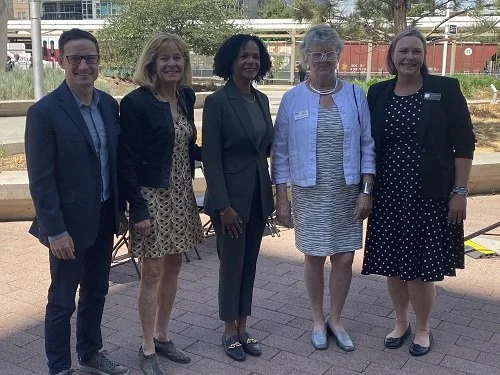
I partnered with DPS Director Carrie Olson and students to draft DPS’s first Climate Action policy that was recognized by Vice President Kamala Harris